


Destinations
The majority of students choose to study for the IB Diploma or Career-related programme at LAB16 because they wish to pursue further education at university either in the UK or abroad. Thanks to the competitive edge of IB students over those that pursue other post-16 pathways, our alumni are studying at an array of universities with an excellent global reputation including Bath, Cambridge, Kings College London, Liverpool, Queen Mary, UCL and Warwick.




Benefits of being an IB student
The IB Diploma and IB Career-related programmes are designed to develop lifelong learners who are capable of more than just passing an exam. Research has shown that many students are ill-prepared for university as they are not able to manage their own time, have poor work ethic or unable to carry out extended writing (The University Admissions Officers Report, 2017). University admission officers value IB students for their curiosity, independent learning, effective time management and cultural understanding.
Research has also shown that IB Diploma students are three times more likely to be accepted into a high-tariff university (e.g. Russell Group) compared to their A Level counterparts (Duxbury et al., 2021). Furthermore, they are 40% more likely to graduate with better outcomes.
IB programmes are recognised globally which makes them an ideal choice for students who are considering furthering their education at a university abroad, or working in a different country.
UCAS Tariff points
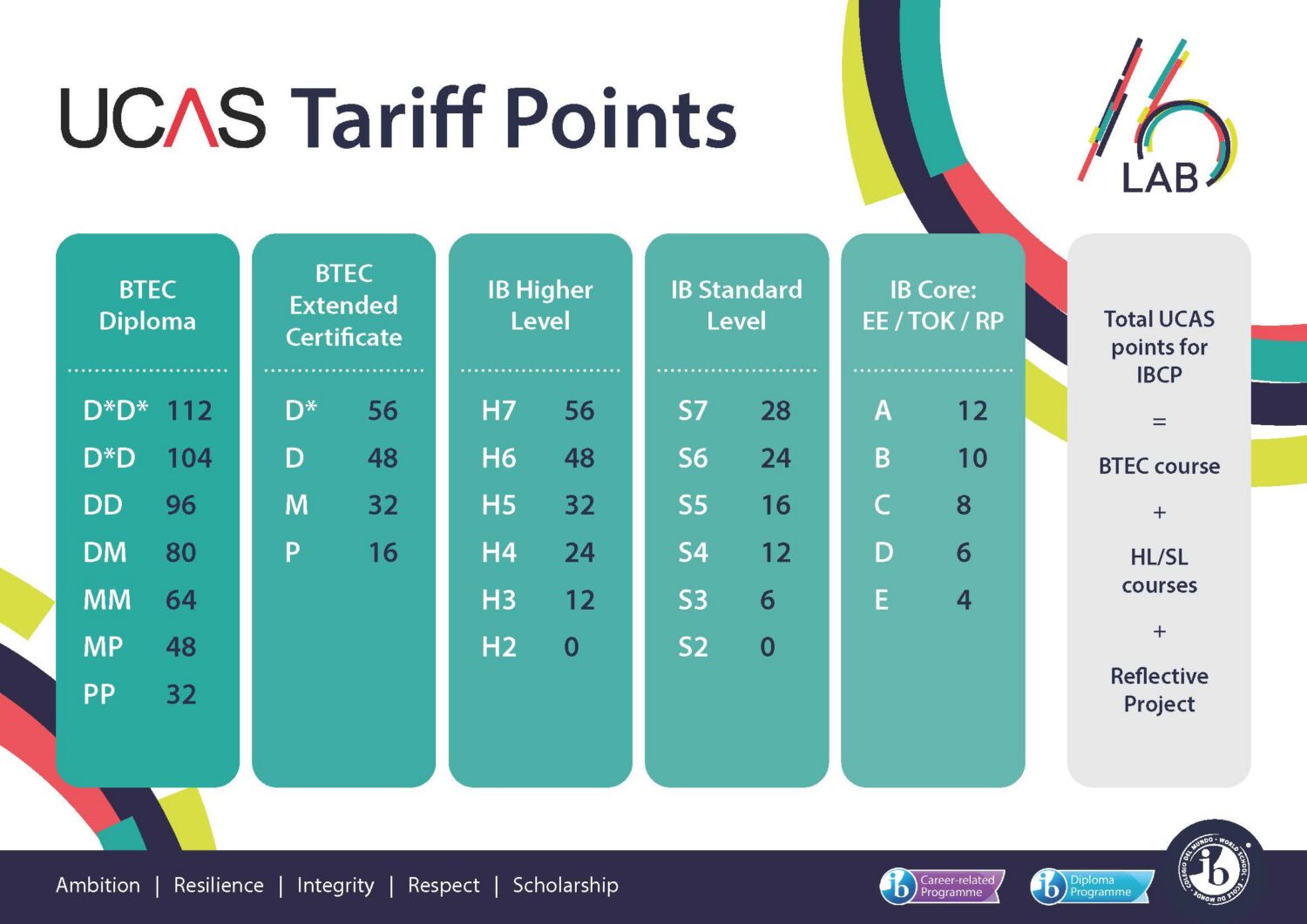
The entry requirements that universities list on their websites can take many forms representing the array of different post-16 qualifications that exist. Many UK universities give their entry requirements in terms of UCAS points which are a standard tariff that grades achieved from recognised qualifications can be converted into.
Another of the benefits that IB students have is that the Diploma and Career-related programmes accumulate a greater number of UCAS points compared to a similar level of achievement in three A Levels. This gives them a competitive advantage over their non-IB peers meaning that they have more options open to them. Below is the UCAS tariff points table for the level 3 courses at Leigh Academy Blackheath.
Supporting students with applying for university
LAB16 students receive a comprehensive support package allowing them to make informed choices about which university or course, and submit competitive applications. This includes:
- Parent/Carer information events
- Attendance at a UCAS Discovery Fair
- Personal guidance meetings with tutors
- Careers adviser meetings
- Two days authorised absence to attend university open days
- Personal statement workshop
- Guidance from experienced UCAS advisers
- Interview preparation and practice
In addition, students are provided with a personal log-in for Unifrog, an online careers guidance platform with various tools and resources to support them with all aspects of applying to university.
Further support is available for students wishing to make an Oxbridge application. We work closely with the admissions teams at Mansfield and Regent’s Park College (University of Oxford) and Gonville & Caius College (University of Cambridge) who regularly visit to speak to students and parents/carers, deliver application and interview workshops, and host bespoke on-campus tours.
Finally, as an IB World School we are assigned a dedicated IB Global Recognition Manager. They actively work with universities in the UK to ensure the standout attributes of IB students are appropriately recognised by admissions officers, whilst in addition can provide us with additional support for students applying to universities abroad. The IB Recognition Database is also a useful tool in understanding how IB results are interpreted by universities across the world.
Useful Websites
- Student Finance: https://www.gov.uk/student-finance
- UCAS: https://www.ucas.com/
- Unifrog: https://www.unifrog.org/
- IB Recognition Database: https://recognition.ibo.org/en-US/
- Student Finance Overview: https://www.youtube.com/watch?v=J6Al_szv8uo
Apprenticeships
Apprenticeships are an excellent pathway for students who wish to pursue further education without attending a university of higher education institution full time. There are many different levels of apprenticeships depending on a student’s age, what qualifications they have completed and their level of achievement. Typically, post-16 students will go on to complete either a ‘Higher Apprenticeship’ (level 4+ and equivalent to a foundation degree or above) or a ‘Degree Apprenticeship’ (level 6+ and equivalent to a bachelor’s or master’s degree).
The comprehensive support package available to support students applying to university will also apply to those applying for an apprenticeship.
Useful Websites
- Amazing Apprenticeships: https://www.amazingapprenticeships.com/
- Degree Apprenticeship Guide: https://www.degreeapprenticeships.guide/
- UCAS: https://www.ucas.com/
- Unifrog: https://www.unifrog.org/